Like Franklin Roosevelt, President Obama presides over a nation in a crisis which is profound and lasting, and where progress is slow.
But the weakness is deeper rooted, more substantial than many people realize. It won't be enough to have a housing bottom (especially where prices remain too high for new families to afford). It won't help to rely on exports as Europe begins to stagnate and China remains locked in destructive mercantilism with systematic trade barriers.
There is more here than only the housing bubble and its collapse.
Like the Great Depression, this collapse was also proceeded by a zooming economy (the roaring 20s and the roaring 90s) with automation, innovation, productivity and tax breaks that helped to create great wealth.
When there is so much wealth unspent that must be invested, a special problem arises.
Since high earners cannot spend all their income and must invest much of it, and when good investments are saturated in an economy, then speculative investments (such as dot com stocks, soaring housing, mortgage-backed securities) follow.
As wealth builds to extraordinary levels, speculation blows into bubbles.
We've have the stock bubble of 1998-2000, the great housing bubble of 1999-2007, the oil price bubble of 2008, and the US Treasury bond bubble of 2009 to the present.
Great wealth with nowhere to go that is productive.
History shows large bubbles and their collapses are devastating and the recoveries are always slow and prolonged (due to debts after asset prices collapse).
As before, many cannot pay what they owe (mostly mortgages), or can pay only by spending little on anything else.
Spending is reduced while productivity still rises, so many jobs are lost, and even a stimulus-aided recovery is slow under the weight of the debts.
These are the well-known effects of bubble collapses in developed economies.
No other result is possible without overwhelming intervention. Without at least a significant intervention (as we have had), a great spiral downward ensues until government does something big enough, and long enough.
How long, how big? Consider: even after Roosevelt's large programs and some good economic growth through the mid 30s that seemed to show light at the end of the tunnel, trying to reduce the federal deficit in 1937 immediately caused a sharp economic relapse.
What finally ended this underlying weakness? We do know that total war mobilization and World War was big enough to free an economy from this kind of lasting weak state.
But something less than total mobilization, and more targeted than we've done so far, could bring us out of this malaise in a lasting way (click here for a specific method of broad debt reduction).
Most Americans don't understand this situation, or the exact effects of the overhang of heavy mortgage debt. Heavy debt seems normal, as it has been around for a decade, and longer for many.
It just doesn't occur to people that a mid-range family income cannot really support $200,000 or more of mortgage debt (while also saving for college and retirement adequately). We are accustomed to many people paying 30%, 35%, and more of their income into a mortgage. We've lost perspective.
We are slogging more slowly than Americans believe we should, and many have no understanding of why and what to do, so they must fall back on simple concepts from talk show hosts and blame the current President.
...
President Roosevelt had two advantages that make President Obama seem weak in comparison.
One primary advantage, as I've explained before in posts on the Great Depression, is that Roosevelt took office many years into the collapse. By 1933, the damage was profound, and no one could pretend it was only about a lack of confidence or not enough freedom for enterprise, or any other partisan guessing.
Instead, it was obvious in 1933 that the economic collapse was something overwhelming, and that it had nothing at all to do with regulation, taxes, freedom, or any of the assertions we hear so often today. 1929-1932 had modest taxes, little regulation. Since then, high growth periods like the 1950s, 60s, and 90s had higher taxes, heavy regulation, welfare, you-name-it. All of those reasons, those talking points, are simply false by evidence of the history of economic growth.
In 2009, as Obama took office, our downturn had not yet progressed to 1933 or 1932 levels, though by the end of 2008 the spiral down was rapidly accelerating. But we responded with stimulus in a way that did not happen in 1930 or 1931....
Our new depression has been held at bay while some of its force was spent and its downward momentum broken, for now. But this depression, like the previous Great Depression, is global, and global effects may yet visit us again.
As we've kept the wolves at bay, not all people have become aware that we were are in a deeper economic crisis.
Many can be told that this glacial recovery is simply Obama's fault. Romney is working hard to establish just this 1984-style, up-is-down 'fact.' (and more, e.g.: Obama wants to "weaken our defense," etc.)
Roosevelt had a profound advantage, coming into the crisis late, after denial was impossible.
But....there is another advantage Roosevelt had, one needed now.
We think Obama is a great speaker, and he is in some ways, so we conclude he has communication down. He's able to communicate, we think.
No.
Roosevelt communicated more clearly, in the face of crisis, because Roosevelt used powerful terms and plain language and called a spade a spade in stark terms that could not be ignored or easily mislabeled. Roosevelt used effective language:
President Obama must realize that most care little about about Race; and we actually want Change. But these constructs are abstractions (!) -- they are not the real center of feeling for most of the nation.
We care about what is the real beating heart of our people -- our relations with each other, and Government is a part, an outer band, of our relation with each other.
This is the real center of the political debate, and the great question of our time.
Are we a people, or are we only a loose alliance?
This question shows underlies most of our debates -- pick a debate, and you are looking at an instance.
Will Obama take FDR's example?
He could.
Showing posts sorted by date for query roosevelt. Sort by relevance Show all posts
Showing posts sorted by date for query roosevelt. Sort by relevance Show all posts
February 16, 2012


February 4, 2011
Stimulus Jump Started Economy
While the Republican party has tried, with some success, to define government spending as useless for economic growth (a new article of faith), economic analysis suggests a very different reality.
The economy has shown real strength in the last few months, with GDP of the U.S. fully recovered back to its previous high of 2007.
Normally, an economy after a major asset (housing) bubble and crash would still be significantly depressed at this point in time. In the Great Depression, both the stock market and housing crashed after a debt bubble, and the unwinding of the economy continued almost 4 years. With Roosevelt's recovery programs it took around 3 more years for national output to recover to 1929 levels, about 7 years in all.
This time the U.S. economy has recovered its previous, 2007-level output (GDP) much faster, returning to peak in around 3 years. In a manner somewhat similar to the Great Depression though, employment has lagged GDP and productivity has soared.
This unusually rapid GDP recovery happened while the stimulus money was spent.
Here's a graph of actual stimulus spending to date (2009 American Recovery and Reinvestment Act -- ARRA):
As you can see, stimulus spending continues at a significant though somewhat reduced rate. But while the rate of spending has decreased in the last few months, the economy has continued to pick up strength -- the recovery has become self-sustaining (for now).
Since the economy has continued to move upward, as shown by the latest improvement in economic indicators, such as the ISM index, we must conclude that the ARRA (the stimulus) led to the unusual economic recovery so soon after the bubble, and effectively created some self-sustaining growth.
In the Great Depression, the American economy did not recover so rapidly, but instead continued to sink for years longer.
It is interesting, and I will be thinking more on this, that in the Great Depression, U.S. GDP had recovered (to 1929 levels) by 1936-37, but unemployment at that time was still much higher than it had been before the Depression started -- roughly 15% vs 5% from before the Depression.
Once again, we have a great lag in employment recovery vs GDP recovery, just as in the Great Depression.
Thankfully though, even our broadest measures of unemployment combined with underemployment and discouraged workers are much better than in the Great Depression, by 8 to 10 or so percentage points, depending on what is counted.
We stopped the slide much sooner, and current employment is many millions higher than it would have been with no stimulus.
Whether this significant, early recovery from such a severe economic injury will sustain its strength remains to be seen, but it is plausible we have avoided a second Great Depression.
If the states and the federal government chart a middle way through deficit reduction -- such as by combining some judicious spending cuts (consider out-of-control U.S. defense procurement spending on new weapons) with some increased taxes on the wealthy, but still allowing for moderate deficits until the economy more fully recovers -- we will continue to mend slowly and time will eventually return our economy to better health.
In 1937, seeing the economic recovery and large Federal deficits, Roosevelt and Congress cut back on federal spending. The result of their austerity was a sharp new recession which drove unemployment up an additional 4 and 1/2 percentage points. The recovery by 1937 was not yet sufficiently self-sustaining to tolerate sharp government cutbacks.
The economy has shown real strength in the last few months, with GDP of the U.S. fully recovered back to its previous high of 2007.
Normally, an economy after a major asset (housing) bubble and crash would still be significantly depressed at this point in time. In the Great Depression, both the stock market and housing crashed after a debt bubble, and the unwinding of the economy continued almost 4 years. With Roosevelt's recovery programs it took around 3 more years for national output to recover to 1929 levels, about 7 years in all.
This time the U.S. economy has recovered its previous, 2007-level output (GDP) much faster, returning to peak in around 3 years. In a manner somewhat similar to the Great Depression though, employment has lagged GDP and productivity has soared.
This unusually rapid GDP recovery happened while the stimulus money was spent.
Here's a graph of actual stimulus spending to date (2009 American Recovery and Reinvestment Act -- ARRA):
As you can see, stimulus spending continues at a significant though somewhat reduced rate. But while the rate of spending has decreased in the last few months, the economy has continued to pick up strength -- the recovery has become self-sustaining (for now).
Since the economy has continued to move upward, as shown by the latest improvement in economic indicators, such as the ISM index, we must conclude that the ARRA (the stimulus) led to the unusual economic recovery so soon after the bubble, and effectively created some self-sustaining growth.
In the Great Depression, the American economy did not recover so rapidly, but instead continued to sink for years longer.
It is interesting, and I will be thinking more on this, that in the Great Depression, U.S. GDP had recovered (to 1929 levels) by 1936-37, but unemployment at that time was still much higher than it had been before the Depression started -- roughly 15% vs 5% from before the Depression.
Once again, we have a great lag in employment recovery vs GDP recovery, just as in the Great Depression.
Thankfully though, even our broadest measures of unemployment combined with underemployment and discouraged workers are much better than in the Great Depression, by 8 to 10 or so percentage points, depending on what is counted.
We stopped the slide much sooner, and current employment is many millions higher than it would have been with no stimulus.
Whether this significant, early recovery from such a severe economic injury will sustain its strength remains to be seen, but it is plausible we have avoided a second Great Depression.
If the states and the federal government chart a middle way through deficit reduction -- such as by combining some judicious spending cuts (consider out-of-control U.S. defense procurement spending on new weapons) with some increased taxes on the wealthy, but still allowing for moderate deficits until the economy more fully recovers -- we will continue to mend slowly and time will eventually return our economy to better health.
In 1937, seeing the economic recovery and large Federal deficits, Roosevelt and Congress cut back on federal spending. The result of their austerity was a sharp new recession which drove unemployment up an additional 4 and 1/2 percentage points. The recovery by 1937 was not yet sufficiently self-sustaining to tolerate sharp government cutbacks.
September 28, 2010
Obama's Catch-22, Or Can A Good President Do Much About A Depression? It's Time to Talk about Reality
Some voters have been trained over the years to believe that Presidents have a decisive influence on the American economy.
Presidents influence the economy much like the captain of a out-of-control supertanker who commands a small auxiliary engine and rudder.
As the tanker itself powers forward, or not, under control of sea conditions and of its own massive engine and sea-spirit-guided rudder.
In calm sea conditions, the captain can gradually have an effect on the tanker's direction if the main engine and rudder aren't pushing in the opposite direction. Or, he can get more influence if he can convince the crew to break open that mysterious door deep in the bowels of the ship and activate the emergency engine in compartment zeta.
The captain might be able to reverse the direction of the supertanker during a full day (a full 4-year Presidential term), if he/she is lucky enough for the large engine and sea spirits to cooperate.
Maybe.
So, can Obama, faced with the beginning of a full-scale great depression, do much about it?
Not unless he can talk about actual economic reality, instead of the normal-to-date practice of hoping for the best and sounding optimistic.
President Roosevelt was able to take dramatic actions in 1933-1935 only and exactly because the Great Depression had so hammered the American economy during 1930-1933 that no one could pretend it was only another slowdown or deny the downward feedback loop.
Today, it is easy for political opportunists and demagogues to pretend that the economy only needs tax cuts, deregulation, etc., to just recover normally (as if it could just roar back to full steam ahead).
This is Obama's catch-22.
President Obama could not safely talk about being in an incipient depression or "lasting downturn" during 2009 because the psychology of everyone suddenly seeing the actual abyss we've entered into would only have intensified the downward plunge.
Talking about reality in 2009 or during the first half of 2010 might have caused the deeper collapse we feared, and have so far avoided.
But not talking about reality -- the known effects on nations of financial bubbles that burst -- prevents us from being able to do anything about it.
...
So the question, now, is whether it is time to talk about getting out of this Depression no. 2. Diplomatically. For instance, about being "still within the powerful hangover from the collapse of the housing bubble and its financial effects on everyone -- savers, businesses and lenders. This is a slump that can continue for years if left to its own slow processes of economic unraveling and rebuilding."
Is it too soon? Will voters be able to understand this isn't just a strong recession or do they need proof, 1932-1933-style proof like we'll get if we have deficit reduction/austerity starting anytime soon?
Presidents influence the economy much like the captain of a out-of-control supertanker who commands a small auxiliary engine and rudder.
As the tanker itself powers forward, or not, under control of sea conditions and of its own massive engine and sea-spirit-guided rudder.
In calm sea conditions, the captain can gradually have an effect on the tanker's direction if the main engine and rudder aren't pushing in the opposite direction. Or, he can get more influence if he can convince the crew to break open that mysterious door deep in the bowels of the ship and activate the emergency engine in compartment zeta.
The captain might be able to reverse the direction of the supertanker during a full day (a full 4-year Presidential term), if he/she is lucky enough for the large engine and sea spirits to cooperate.
Maybe.
So, can Obama, faced with the beginning of a full-scale great depression, do much about it?
Not unless he can talk about actual economic reality, instead of the normal-to-date practice of hoping for the best and sounding optimistic.
President Roosevelt was able to take dramatic actions in 1933-1935 only and exactly because the Great Depression had so hammered the American economy during 1930-1933 that no one could pretend it was only another slowdown or deny the downward feedback loop.
Today, it is easy for political opportunists and demagogues to pretend that the economy only needs tax cuts, deregulation, etc., to just recover normally (as if it could just roar back to full steam ahead).
This is Obama's catch-22.
President Obama could not safely talk about being in an incipient depression or "lasting downturn" during 2009 because the psychology of everyone suddenly seeing the actual abyss we've entered into would only have intensified the downward plunge.
Talking about reality in 2009 or during the first half of 2010 might have caused the deeper collapse we feared, and have so far avoided.
But not talking about reality -- the known effects on nations of financial bubbles that burst -- prevents us from being able to do anything about it.
...
So the question, now, is whether it is time to talk about getting out of this Depression no. 2. Diplomatically. For instance, about being "still within the powerful hangover from the collapse of the housing bubble and its financial effects on everyone -- savers, businesses and lenders. This is a slump that can continue for years if left to its own slow processes of economic unraveling and rebuilding."
Is it too soon? Will voters be able to understand this isn't just a strong recession or do they need proof, 1932-1933-style proof like we'll get if we have deficit reduction/austerity starting anytime soon?
Do we need to continue to pretend a recovery is soon to lift us upward, in order to maintain some confidence?
I think the right time to talk about reality is now, because most people have already lost confidence in an oncoming recovery.
There is little real confidence to protect.
Obama should address the nation, from the oval office, and explain exactly where we are, using such economic history as Rogoff and Reinhart on the normal outcome of financial crises. He should explain what happens in every nation consistently when a credit or asset (housing) bubble inflates then collapses.
He needs to lay out this knowledge clearly to the American people, so that we can start to talk about the way things actually are, and not be caught any longer in illusions.
It would help greatly to talk in ways that cut through the jargon and create understanding -- he should explain to Americans the savings conundrum and why is it necessary for the government to reinvest the excess private savings to prevent a continuing downward spiral. He should talk of investing in America for our future, until economic growth picks up strongly enough to significantly raise the demand of businesses for new loans as shown by natural interest rates.
President Obama should explain how we can increase future productivity and economic growth by investing to produce a stronger economy 2, 3 and 10 years from now.
Obama needs to lay out for the American people a road out of depression.
Of course, he needs to use language more along the lines: "Reinvesting in our future to restore the growth and optimism America has known since the huge investments of the 1940s, 50s and 60s."
This is a key point -- that the tremendous prosperity America has known has been the result of massive federal investments in the 1940s, 1950s, and 1960s.
That's reality, and not enough Americans know it.
We need to cancel the distortion field by talking about reality.
I think the right time to talk about reality is now, because most people have already lost confidence in an oncoming recovery.
There is little real confidence to protect.
Obama should address the nation, from the oval office, and explain exactly where we are, using such economic history as Rogoff and Reinhart on the normal outcome of financial crises. He should explain what happens in every nation consistently when a credit or asset (housing) bubble inflates then collapses.
He needs to lay out this knowledge clearly to the American people, so that we can start to talk about the way things actually are, and not be caught any longer in illusions.
It would help greatly to talk in ways that cut through the jargon and create understanding -- he should explain to Americans the savings conundrum and why is it necessary for the government to reinvest the excess private savings to prevent a continuing downward spiral. He should talk of investing in America for our future, until economic growth picks up strongly enough to significantly raise the demand of businesses for new loans as shown by natural interest rates.
President Obama should explain how we can increase future productivity and economic growth by investing to produce a stronger economy 2, 3 and 10 years from now.
Obama needs to lay out for the American people a road out of depression.
Of course, he needs to use language more along the lines: "Reinvesting in our future to restore the growth and optimism America has known since the huge investments of the 1940s, 50s and 60s."
This is a key point -- that the tremendous prosperity America has known has been the result of massive federal investments in the 1940s, 1950s, and 1960s.
That's reality, and not enough Americans know it.
We need to cancel the distortion field by talking about reality.
April 22, 2010
(3rd Update) The Problem With Staving Off A Great Depression
...is that about half the people will conclude that since there isn't another great depression (so far), that this means that one wasn't going to happen.
Using the same presumptions, many will decide that the depth of the recession we've had proves the stimulus (the $787 billion American Recovery and Reinvestment Act, or ARRA) didn't work.
To help them fall into this circular logic (no depression + deep recession proves stimulus didn't work), they'll be aided by ideologues who know little about business or economics, and offer utter nonsense as their own brand of economics, such as: "The stimulus hasn't created one single job."
This intentionally ambiguous statement might be taken to assert either that no extra jobs have been created on net when we include the public and private sectors together, or alternatively that no private sectors jobs were created on net versus what would have happened without a stimulus.
But jobs in an economy depend on the total demand in the economy for goods and services. And that total demand depends on all spending, public and private.
Because the stimulus increased the total spending (versus the situation without a stimulus), the simple result is that private businesses in the U.S. have had more total demand for their products than they would have absent this stimulus.
Therefore, inevitably and absolutely, there are now more private sectors jobs in America than there would have been without this stimulus.
(2nd Update: There are not only simply more private sector jobs than would have been without the ARRA stimulus, but private sector employment has been increasing some lately.)
But a bigger situation is at hand than only net job results.
The U.S. has experienced something unusual -- the collapse of a major bubble of house prices and consumer debt.
Such collapses do no result in ordinary recessions.
As Rogoff and Reinhardt have shown, such collapses result in deep, long recessions. Great recessions. Sometimes called depressions.
Worse, we know that when the bubble is large, as ours was, the result can be a great depression that continues to deepen for years.
A downward spiral that doesn't let up, if no Government stimulus intervenes.
Now, it would be one thing for a modest minority of Americans to believe such nonsense as thinking the ARRA had little or no positive net effect on jobs, but the problem of economic/political perceptions is bigger here.
Many people can't truly conceive of immense events.
Essentially, they think overwhelming events are mostly just movies, and distant history.
It can't happen here....
The unconscious mind rationalizes to make this seem true:
-- Really bad catastrophes are...things that happen to other people, and...we're an unique nation with freedom...so, if something bad once happened economically to us, then it must have been due to a governmental mistake, since our system (free market) is naturally without flaw, therefore such a governmental mistake must explain the great depression.
e.g.:
-- The Great Depression must have been caused mostly by one-time events like the Smoot-Hawley Tariff.
-- The Black Plague (the Black Death) was a once-in-history thing, a one-time event in the Universe, like Noah's flood.
-- Or simply: It can't happen here.
Knowing vaguely that there was an American and international Great Depression, or that maybe some American earthquake once might have killed more than a few hundred just isn't enough for many people to comprehend that indeed....
It can happen to us.
Instead, many people believe, despite living in fire territory and watching fires on television, that fires happen to other people.
Some simply will not believe a wildfire can burn their house down, until, literally, they see it burning, collapsing in flame, or come back and are shocked that indeed, it burned.
This isn't all bad. Some people could not handle the stress of knowing that such things happen more often than we think.
And besides, it usually doesn't happen here.
These are the "show me" people.
But an even larger group of people have beliefs that are carefully protected from any contradicting evidence. Such information is ignored or discounted. Beliefs which are independent of reality, in short. We often call this "ideology," but in America an even deeper force than mere ideas is at work. (more on this in a coming post)
...
Obama's position is far more difficult than that of FDR (President Franklin Roosevelt).
FDR entered office in March 1933, after the Great Depression had so ravaged the nation that 1/5 of jobs had disappeared and a general bank run was progressing. True fear was becoming widespread.
FDR took office closer to 4 years than to 3 into the economic collapse.
People believed it could happen.
Because it had.
Obama has the vastly more difficult situation of having staved off a great depression, starting only a year in, before it could truly reveal itself.
1930 wasn't so bad yet. It was '31-'33 that really made it the "Great" Depression.
Many people will never know what Obama has helped to save them from, unless more economic shocks (perhaps from overseas, such as debt crises (Greece et al)) reduce confidence and abort the tentative recovery (for which confidence is one of three legs).
Fires are not always under control when "mostly contained."
The wind can shift. The fire can "blow up."
If that happens, we might do little under our current politics, and have some extraordinary real-world learning coming our way.
When an adult refuses to believe that fire burns, it may be necessary to simply stand back and remind them one last time of the idea:"fire burns." Mentally, at such a final juncture, one just makes a plan of how to respond after the fact.
This contingency is why it's so crucial for the U.S. to have truly long-term investments under way. We may end up in a great depression, and if that happens, those long-term investments, like education and science and technology -- that pay off 6 and 8 and 10 years later -- will be our salvation, just as the innovations of World War II helped propel the American economy through the 1950s.
It also would help greatly to replace taxes on domestic production (corporate taxes that raise the costs of American manufacturing and services) with taxes on consumption (sales taxes), as other nations do -- so as to help level the playing field for American workers competing against foreign workers. Such a good change in tax law could significantly reduce the export of American jobs. It would mean your job and mine are more secure, and would pay more, than under our current tax structure.
Using the same presumptions, many will decide that the depth of the recession we've had proves the stimulus (the $787 billion American Recovery and Reinvestment Act, or ARRA) didn't work.
To help them fall into this circular logic (no depression + deep recession proves stimulus didn't work), they'll be aided by ideologues who know little about business or economics, and offer utter nonsense as their own brand of economics, such as: "The stimulus hasn't created one single job."
This intentionally ambiguous statement might be taken to assert either that no extra jobs have been created on net when we include the public and private sectors together, or alternatively that no private sectors jobs were created on net versus what would have happened without a stimulus.
But jobs in an economy depend on the total demand in the economy for goods and services. And that total demand depends on all spending, public and private.
Because the stimulus increased the total spending (versus the situation without a stimulus), the simple result is that private businesses in the U.S. have had more total demand for their products than they would have absent this stimulus.
Therefore, inevitably and absolutely, there are now more private sectors jobs in America than there would have been without this stimulus.
(2nd Update: There are not only simply more private sector jobs than would have been without the ARRA stimulus, but private sector employment has been increasing some lately.)
But a bigger situation is at hand than only net job results.
The U.S. has experienced something unusual -- the collapse of a major bubble of house prices and consumer debt.
Such collapses do no result in ordinary recessions.
As Rogoff and Reinhardt have shown, such collapses result in deep, long recessions. Great recessions. Sometimes called depressions.
Worse, we know that when the bubble is large, as ours was, the result can be a great depression that continues to deepen for years.
A downward spiral that doesn't let up, if no Government stimulus intervenes.
Now, it would be one thing for a modest minority of Americans to believe such nonsense as thinking the ARRA had little or no positive net effect on jobs, but the problem of economic/political perceptions is bigger here.
Many people can't truly conceive of immense events.
Essentially, they think overwhelming events are mostly just movies, and distant history.
It can't happen here....
The unconscious mind rationalizes to make this seem true:
-- Really bad catastrophes are...things that happen to other people, and...we're an unique nation with freedom...so, if something bad once happened economically to us, then it must have been due to a governmental mistake, since our system (free market) is naturally without flaw, therefore such a governmental mistake must explain the great depression.
e.g.:
-- The Great Depression must have been caused mostly by one-time events like the Smoot-Hawley Tariff.
-- The Black Plague (the Black Death) was a once-in-history thing, a one-time event in the Universe, like Noah's flood.
-- Or simply: It can't happen here.
Knowing vaguely that there was an American and international Great Depression, or that maybe some American earthquake once might have killed more than a few hundred just isn't enough for many people to comprehend that indeed....
It can happen to us.
Instead, many people believe, despite living in fire territory and watching fires on television, that fires happen to other people.
Some simply will not believe a wildfire can burn their house down, until, literally, they see it burning, collapsing in flame, or come back and are shocked that indeed, it burned.
This isn't all bad. Some people could not handle the stress of knowing that such things happen more often than we think.
And besides, it usually doesn't happen here.
These are the "show me" people.
But an even larger group of people have beliefs that are carefully protected from any contradicting evidence. Such information is ignored or discounted. Beliefs which are independent of reality, in short. We often call this "ideology," but in America an even deeper force than mere ideas is at work. (more on this in a coming post)
...
Obama's position is far more difficult than that of FDR (President Franklin Roosevelt).
FDR entered office in March 1933, after the Great Depression had so ravaged the nation that 1/5 of jobs had disappeared and a general bank run was progressing. True fear was becoming widespread.
FDR took office closer to 4 years than to 3 into the economic collapse.
People believed it could happen.
Because it had.
Obama has the vastly more difficult situation of having staved off a great depression, starting only a year in, before it could truly reveal itself.
1930 wasn't so bad yet. It was '31-'33 that really made it the "Great" Depression.
Many people will never know what Obama has helped to save them from, unless more economic shocks (perhaps from overseas, such as debt crises (Greece et al)) reduce confidence and abort the tentative recovery (for which confidence is one of three legs).
Fires are not always under control when "mostly contained."
The wind can shift. The fire can "blow up."
If that happens, we might do little under our current politics, and have some extraordinary real-world learning coming our way.
When an adult refuses to believe that fire burns, it may be necessary to simply stand back and remind them one last time of the idea:"fire burns." Mentally, at such a final juncture, one just makes a plan of how to respond after the fact.
This contingency is why it's so crucial for the U.S. to have truly long-term investments under way. We may end up in a great depression, and if that happens, those long-term investments, like education and science and technology -- that pay off 6 and 8 and 10 years later -- will be our salvation, just as the innovations of World War II helped propel the American economy through the 1950s.
It also would help greatly to replace taxes on domestic production (corporate taxes that raise the costs of American manufacturing and services) with taxes on consumption (sales taxes), as other nations do -- so as to help level the playing field for American workers competing against foreign workers. Such a good change in tax law could significantly reduce the export of American jobs. It would mean your job and mine are more secure, and would pay more, than under our current tax structure.
April 24, 2009
The Great Depression...and Now (updated 6-09)
While listening to Simon Johnson on Bill Moyer's Journal tonight, it struck me that the primary cause of the Great Depression, the main factor that deepened then prolonged the 1929-30 recession, isn't clear for many people. Near the end of the first segment in Moyer's program, Simon quips that economists will still be debating the Great Depression 50 years from now. While some may, I believe we can decipher these events in a way that will decisively end the general debate soon.
When I reflect on the hundreds of articles and blog posts I've read on the Great Depression and our situation now, and on my own evolving thoughts over the last two years, one fundamental economic process stands out in this grand worldwide train wreck. Let me illustrate this decisive force and its play within the complex string of events.
The 1929 recession came after a period of significantly increasing consumer installment and mortgage debt. When a growing stock speculation bubble continued in 1928, the Federal Reserve raised rates to slow the expanding stock borrowing. A recession began in the summer of 1929, which in turn helped destabilize the stock market bubble, leading to the October crash, which contributed to a reduction in demand and availability of consumer credit. As job losses mounted from the 1929 recession into 1930-1931, increasing numbers of bank loans went bad, which made more and more banks reluctant to lend just as more consumers became reluctant to borrow. Banks were taking in payments from those able to pay on their (still significant) debts, but not lending out much. This was a reversal of the run-up in credit, and the deflation which followed made debts harder to pay and the balloon mortgages unrefinanceable.
Various other effects further crimped demand and income: tax increases meant to gather more revenues from those still working, and trade wars which destroyed jobs in export industries.
As the job losses and fear mounted, many with jobs became more cautious in spending what they had. The circle of reduced spending leading to job losses which in turn further reduced spending drove the economy downward towards its essentials, its base, where what was being produced and sold were largely necessities. The slide continued under its own momentum.
By early 1933, this process had advanced far enough and long enough that the remaining demand and economy still in operation was the harder stuff of necessity. From this point, it should be no surprise that Roosevelt and Congress were able to quickly halt the downward drift and move things upward by ending the bank runs for the surviving (hardier) banks with new FDIC insurance, by widening economic rescue efforts, and by calming the people with fireside chats.
By 1933 the weak, frothy parts of the 1929 economy were all gone, and only the strong, hard base remained, ready to build upon.
Nevertheless, people had been trained into frugality by this time, and the debt burden was still significant. It would take years of gradual psychological gains in general confidence and the gradual development and appearance of new products and new wants to strengthen and broaden the economy so that more and more people could find work. Time was required to re-weave economic fabric exactly because so many who had lost jobs were also broke and had unpaid debts, so that even when they worked they were still miserly. World War II capped this process of slowly building up jobs and paying down debt, ending the remaining lack of demand and unemployment and accelerating technological innovation. By the end of the war, the U.S. was prepared in all essential ways for significant economic growth -- with increased general confidence and new technology ready to be put to work -- and only needed to be turned loose from wartime governmental control, which is exactly what happened next.
An analogy for America and its economy of 1928-1945 would be a story that starts with a drunk driver on a mountain road.
Drunk on overindulgence (stock speculation and debt) and driving too fast, our Driver careens into roadside trees at high speed (October 1929). But then worse, our hero tumbles down the cliff face (1930-31), taking further injuries, and finally goes without help or food for days (1931-33).
After what seems an eternity, our desperately injured Driver is finally rescued and put in hospital for a long, slow recovery (1933-1940). After gradually regaining health in this painful, slow recovery, our patient is then put into a strenuous, lengthy physical therapy program (WWII).
Finally, our Driver is released one day (1945), after what seems ages, now hale and full of strength and power, his confidence restored. He is a new man.
...
Will it take us 10 or 12 years to get back to a thriving economy?
Only if we have years of downward spiral, which is a threat due to the weight of household debts. And for the "thriving" part -- only if we undergo serious re-conditioning.
But our tumble down the cliff (joblessness) is being seriously fought and contested by the Fed and the Federal stimulus program, with multiple ropes.
Our modern Accident included air bags.
Rescuers are hard at work, bringing the Driver water and oxygen through the broken car window, hanging by ropes on the face of the cliff.
We may not need a 12-year recovery -- we have not yet suffered 1931-1933.
The ropes are creaking, and several have snapped or slipped off, but others have been hurriedly attached.
Nothing is clear yet at this point. ...Except, perhaps, that the old jalopy is totaled.
Nothing is certain. The car may yet go tumbling, or the ropes may hold.
----
Update: Here is a good source of ongoing world economy graphs showing our progress vs. the Great Depression. It takes time for the effects of the stimulus program, and also of general confidence to show up in this kind of data. Perhaps by late summer we will have a better idea whether the world economy can deviate upward from the Great Depression trends we have followed so far.
When I reflect on the hundreds of articles and blog posts I've read on the Great Depression and our situation now, and on my own evolving thoughts over the last two years, one fundamental economic process stands out in this grand worldwide train wreck. Let me illustrate this decisive force and its play within the complex string of events.
The 1929 recession came after a period of significantly increasing consumer installment and mortgage debt. When a growing stock speculation bubble continued in 1928, the Federal Reserve raised rates to slow the expanding stock borrowing. A recession began in the summer of 1929, which in turn helped destabilize the stock market bubble, leading to the October crash, which contributed to a reduction in demand and availability of consumer credit. As job losses mounted from the 1929 recession into 1930-1931, increasing numbers of bank loans went bad, which made more and more banks reluctant to lend just as more consumers became reluctant to borrow. Banks were taking in payments from those able to pay on their (still significant) debts, but not lending out much. This was a reversal of the run-up in credit, and the deflation which followed made debts harder to pay and the balloon mortgages unrefinanceable.
Various other effects further crimped demand and income: tax increases meant to gather more revenues from those still working, and trade wars which destroyed jobs in export industries.
As the job losses and fear mounted, many with jobs became more cautious in spending what they had. The circle of reduced spending leading to job losses which in turn further reduced spending drove the economy downward towards its essentials, its base, where what was being produced and sold were largely necessities. The slide continued under its own momentum.
By early 1933, this process had advanced far enough and long enough that the remaining demand and economy still in operation was the harder stuff of necessity. From this point, it should be no surprise that Roosevelt and Congress were able to quickly halt the downward drift and move things upward by ending the bank runs for the surviving (hardier) banks with new FDIC insurance, by widening economic rescue efforts, and by calming the people with fireside chats.
By 1933 the weak, frothy parts of the 1929 economy were all gone, and only the strong, hard base remained, ready to build upon.
Nevertheless, people had been trained into frugality by this time, and the debt burden was still significant. It would take years of gradual psychological gains in general confidence and the gradual development and appearance of new products and new wants to strengthen and broaden the economy so that more and more people could find work. Time was required to re-weave economic fabric exactly because so many who had lost jobs were also broke and had unpaid debts, so that even when they worked they were still miserly. World War II capped this process of slowly building up jobs and paying down debt, ending the remaining lack of demand and unemployment and accelerating technological innovation. By the end of the war, the U.S. was prepared in all essential ways for significant economic growth -- with increased general confidence and new technology ready to be put to work -- and only needed to be turned loose from wartime governmental control, which is exactly what happened next.
An analogy for America and its economy of 1928-1945 would be a story that starts with a drunk driver on a mountain road.
Drunk on overindulgence (stock speculation and debt) and driving too fast, our Driver careens into roadside trees at high speed (October 1929). But then worse, our hero tumbles down the cliff face (1930-31), taking further injuries, and finally goes without help or food for days (1931-33).
After what seems an eternity, our desperately injured Driver is finally rescued and put in hospital for a long, slow recovery (1933-1940). After gradually regaining health in this painful, slow recovery, our patient is then put into a strenuous, lengthy physical therapy program (WWII).
Finally, our Driver is released one day (1945), after what seems ages, now hale and full of strength and power, his confidence restored. He is a new man.
...
Will it take us 10 or 12 years to get back to a thriving economy?
Only if we have years of downward spiral, which is a threat due to the weight of household debts. And for the "thriving" part -- only if we undergo serious re-conditioning.
But our tumble down the cliff (joblessness) is being seriously fought and contested by the Fed and the Federal stimulus program, with multiple ropes.
Our modern Accident included air bags.
Rescuers are hard at work, bringing the Driver water and oxygen through the broken car window, hanging by ropes on the face of the cliff.
We may not need a 12-year recovery -- we have not yet suffered 1931-1933.
The ropes are creaking, and several have snapped or slipped off, but others have been hurriedly attached.
Nothing is clear yet at this point. ...Except, perhaps, that the old jalopy is totaled.
Nothing is certain. The car may yet go tumbling, or the ropes may hold.
----
Update: Here is a good source of ongoing world economy graphs showing our progress vs. the Great Depression. It takes time for the effects of the stimulus program, and also of general confidence to show up in this kind of data. Perhaps by late summer we will have a better idea whether the world economy can deviate upward from the Great Depression trends we have followed so far.
March 15, 2009
(Major Update 3/18) Huge Bonuses at AIG (but Not for the specific individuals that created the CDS disaster!)
A rare moment has arrived.
The New York Times reports:
Executives of the unit that made the huge derivative bets that A.I.G. could never cover if the housing market went south (but, see update 3-18 below) -- those are the people getting the big money, here. Since these were bets A.I.G. could not cover, the implicit situation from the beginning was that the U.S. taxpayer -- you and I -- would be on the hook to cover their greedy bets if things went too badly.
I seriously doubt the intelligent, knowledgeable reporters of the Times and other national media understand how explosive this is.
They reasonably report the rationales in the article -- contractual obligations made in early 2008 that "cannot" be broken.
I don't think most people in D.C. or in much of the national media really know what is going on in the middle class.
The median wage in the U.S. is about $41,000.
National reporters and members of Congress and lobbyists bring in quite a lot more than that. They simply don't have a direct experience of being in the middle class recently, and don't know what most people will think once they learn of this.
So they won't be able to fully anticipate the fallout from this is instance of corruption.
The contracts should have been broken. If necessary, the Chairman of the Board should have been immediately dismissed if he would not do so, no matter how competent and excellent a chairman he is otherwise. He should be immediately dismissed if he would not carry out the will of the majority stockholders -- you and me.
The U.S. would then have likely had to go to court, and defend this abrogation. The correct course of action would be to defend an abrogation, regardless of outcome, all the way to the U.S. Supreme Court. It would not be important to win. It's vastly important to fight for what is right.
That might have been enough to prevent most of the coming fallout.
Even now, correct action would be dramatic -- to seize the bonus money or freeze the deposits that have been transferred, pending an outcome.
The coming fallout is unpredictable, but it will happen, whether it is dramatic and soon, or more subtle and lasting like the aftermath of a neutron bomb, where little damage is readily apparent at first.
Congress and the Administration have a few days in which to do something.
Saying they are "outraged" is not enough. It is worse than nothing.
The Obama administration should consider whether they are willing to lose as much as 5 or 10 points (and possibly more) of their national approval rating in a week or two.
What could be done now?
"I am directing [The Department of Justice] to temporarily freeze these bonus funds and already deposited amounts pending further legal review as to whether we should challenge these contracts [in a court of law] due to the exceptional circumstances of contradiction here between performance and reward."
Update 3-17 (good news):
Link to CNN story here:
The New York Times reports:
The American International Group, which has received more than $170 billion in taxpayer bailout money from the and Federal Reserve, plans to pay about $165 million in bonuses by Sunday to executives in the same business unit that brought the company to the brink of collapse last year.
Executives of the unit that made the huge derivative bets that A.I.G. could never cover if the housing market went south (but, see update 3-18 below) -- those are the people getting the big money, here. Since these were bets A.I.G. could not cover, the implicit situation from the beginning was that the U.S. taxpayer -- you and I -- would be on the hook to cover their greedy bets if things went too badly.
I seriously doubt the intelligent, knowledgeable reporters of the Times and other national media understand how explosive this is.
They reasonably report the rationales in the article -- contractual obligations made in early 2008 that "cannot" be broken.
I don't think most people in D.C. or in much of the national media really know what is going on in the middle class.
The median wage in the U.S. is about $41,000.
National reporters and members of Congress and lobbyists bring in quite a lot more than that. They simply don't have a direct experience of being in the middle class recently, and don't know what most people will think once they learn of this.
So they won't be able to fully anticipate the fallout from this is instance of corruption.
The contracts should have been broken. If necessary, the Chairman of the Board should have been immediately dismissed if he would not do so, no matter how competent and excellent a chairman he is otherwise. He should be immediately dismissed if he would not carry out the will of the majority stockholders -- you and me.
The U.S. would then have likely had to go to court, and defend this abrogation. The correct course of action would be to defend an abrogation, regardless of outcome, all the way to the U.S. Supreme Court. It would not be important to win. It's vastly important to fight for what is right.
That might have been enough to prevent most of the coming fallout.
Even now, correct action would be dramatic -- to seize the bonus money or freeze the deposits that have been transferred, pending an outcome.
The coming fallout is unpredictable, but it will happen, whether it is dramatic and soon, or more subtle and lasting like the aftermath of a neutron bomb, where little damage is readily apparent at first.
Congress and the Administration have a few days in which to do something.
Saying they are "outraged" is not enough. It is worse than nothing.
The Obama administration should consider whether they are willing to lose as much as 5 or 10 points (and possibly more) of their national approval rating in a week or two.
What could be done now?
"I am directing [The Department of Justice] to temporarily freeze these bonus funds and already deposited amounts pending further legal review as to whether we should challenge these contracts [in a court of law] due to the exceptional circumstances of contradiction here between performance and reward."
Update 3-17 (good news):
Link to CNN story here:
WASHINGTON (CNN) -- President Barack Obama said Monday he will attempt to block bonuses to executives at ailing insurance giant AIG, payments he described as an "outrage."
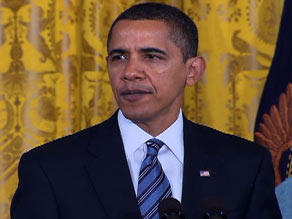
President Obama says AGI "finds itself in financial distress due to recklessness and greed."
 1 of 3

"This is a corporation that finds itself in financial distress due to recklessness and greed," Obama told politicians and reporters in the Roosevelt Room of the White House, where he and Treasury Secretary Tim Geithner were unveiling a package to aid the nation's small businesses.
The president expressed dismay and anger over the bonuses to executives at AIG, which has received $173 billion in U.S. government bailouts over the past six months.
"Under these circumstances, it's hard to understand how derivative traders at AIG warranted any bonuses, much less $165 million in extra pay. I mean, how do they justify this outrage to the taxpayers who are keeping the company afloat?"
...
But he said the impropriety of the bonuses goes beyond economics. "It's about our fundamental values," he said.
------------------------------
Update 3-18 (Liddy finally tells us)
I heard this bit on NPR this evening:
Liddy: "The people who were primarily responsible for Credit Default Swaps (CDS) that brought us to our knees -- they're gone. The people who were responsible for regulatory capital trades that have some exposure -- they're gone. But the people who still operate a $1.6 trillion trading book of business -- we aren't loosing the kind of dollars on that that we've lost on Credit Default Swaps. They are still there, and they're the ones that are winding that book of business down." [They got the retention bonuses?] Yes, they did."
Barney Frank: "So you're telling me the only bonuses that were paid recently are the retention bonuses?"
Liddy: "Yes."
Frank: "There were no other bonuses paid?"
Liddy: "Not at AIG FP. No, I don't think so."
So....we are left to wonder why this wasn't pointed out 2 days earlier. Did Liddy simply not understand the significance of this? I think he did not actually.
Even now, this new revelation that these bonuses were not for the CDS traders that most destroyed AIG isn't making the splash it should. This is because in the bigger picture, regardless that these bonuses aren't being paid to many of the worst offenders of the AIG of 2008 (or 2006, etc.), people still are aghast that there are such large bonuses at AIG, of any kind, to anyone.
The picture is still that just moderately clever folks doing trading and "winding down trades" are supposed to be worth millions, while a teacher or a plumber earns under $100,000 or under $50,000. This is justified on the basis that these traders are needed to prevent counterparties from taking advantage of taxpayer-owned AIG now.
And this is the essence of the larger problem. That trading (gambling) caused the problem, and now we are paying other traders to help mitigate it, and paying them millions.
That traders are worth millions each year, but scientists, teachers, engineers -- people who actually produce real gains for society -- are not.
Subscribe to:
Posts (Atom)

 Posts
Posts

