I thought it would be good to give just a 2-minute, off-the-cuff sketch of Where We Are, without many explanations (see previous posts for these). Just a quick bunch of thoughts.
After a 30-year, massive credit/debt boom aided by advertising, the ratio of American household indebtedness vs. income rose to levels similar to the peak in 1932 , and even doubled vs. incomes over 30 years. When the last easy-money extreme -- NINJA loans -- finally faltered, the bubble of credit began to reverse in late 2007, and house prices began their downward return towards normal. In response, people are trying to save for retirement since their houses and stocks are worth considerably less.
The change in consumer spending is likely to be semi-permanent (lasting, and only partially reversing), and that's for the people who have jobs. Meanwhile, jobs servicing the artificially high demand of the credit-bubble times are being lost, and that will be huge.
Rogoff and Reinhart's study of past financial bubbles shows it's likely that house prices will continue down for years more, and jobs losses are likely for years. The average GDP decline after such busts is 9%.
The Fed is acting more aggressively than ever before, yet how can extra credit availability matter when people everywhere simply choose to save? Consumers choose to save regardless, and businesses will choose to be conservative regardless of credit availability, since we all see the same reality. One way the Fed can do something meaningful is to manage to get mortgage rates under 5% and hold them there for a long time, thus freeing up more discretionary spending for many households after they refinance.
In short, one necessity to help prevent a Long Slump (near Depression-like) that lasts more than 3 years is by somehow creating effective incentives to start new kinds of industry and business to produce new kinds of products and services that people want and do not already have.
Obama may realize this in part, but it's not yet clear how well.
That's where we are.
.......................
(Extra note: The Administration and Congress should not lowball the incentives for new business and job creation when they legislate. There is a tendency to work on the margin (for instance Obama's 2008 idea of a $3000 tax credit for new jobs). We will need something much more powerful, such as a 20% subsidy in the first year on the first $1 million of domestic investment and/or payroll increases that create jobs on net, paid a year later based on payroll continuation, and the percentage attenuating over 3 years, for instance. It's not at all hard to set up rules to prevent substitutions or other abuse of such a subsidy. I could do it in an hour, and so could many experienced businesspeople.)
March 20, 2009


March 19, 2009
Our Real Economic Problem
We hear endless analysis by intelligent writers and reporters of all stripes on our economic situation, but rarely hear of one of our most central economic problems.
Much damage in our economy results from incentives -- many of the most productive workers in our society are earning barely enough, and some struggle, while much greater rewards (and thus incentives) go to activities of little net benefit .
Average wages (including benefits):
Teachers -- $43,000
Engineers -- $66,000
Carpenters -- $30,000
Auto Mechanics -- $32,000
While the average derivatives trader in New York state makes about 3 times the average New York state wage:
Derivatives Trader in NY state (NYC is only $8000 more) -- $126,000
Average NY state wage -- $46,000
But traders make their living off of the rest of us.
How?
The value of money is created by what it can buy -- goods and services that working people produce. Money has value because people create goods or services you actually need to live and want to have for enjoyment.
But traders do not produce goods or services we need or want. Instead, they find ways to make stocks or gasoline supplies or other things we need or want to buy more expensive when we purchase them, pocketing the extra cost they have created.
We set up our economy to reward gambling and trading that adds costs to average American lives, and at a salary rate of two and three times that of ordinary American jobs.
This set of incentives created our our Real Economic Problem, as trading expanded until it destroyed the structure of the whole economy.
We are now suffering the outcome and consequences.
Much damage in our economy results from incentives -- many of the most productive workers in our society are earning barely enough, and some struggle, while much greater rewards (and thus incentives) go to activities of little net benefit .
Average wages (including benefits):
Teachers -- $43,000
Engineers -- $66,000
Carpenters -- $30,000
Auto Mechanics -- $32,000
While the average derivatives trader in New York state makes about 3 times the average New York state wage:
Derivatives Trader in NY state (NYC is only $8000 more) -- $126,000
Average NY state wage -- $46,000
But traders make their living off of the rest of us.
How?
The value of money is created by what it can buy -- goods and services that working people produce. Money has value because people create goods or services you actually need to live and want to have for enjoyment.
But traders do not produce goods or services we need or want. Instead, they find ways to make stocks or gasoline supplies or other things we need or want to buy more expensive when we purchase them, pocketing the extra cost they have created.
We set up our economy to reward gambling and trading that adds costs to average American lives, and at a salary rate of two and three times that of ordinary American jobs.
This set of incentives created our our Real Economic Problem, as trading expanded until it destroyed the structure of the whole economy.
We are now suffering the outcome and consequences.
March 18, 2009
"We're on New Ground"
This is quite a discussion from Charlie Rose, and even people in a hurry would not want to miss anything after around 28 minutes into the program, such as Meredith Whitney for instance. I especially recommend what Hank Greenberg says towards 32 1/2 minutes onwards.
While the whole video is really worth it, here's an excerpt of Hank Greenberg at that point for those who want to see it in print (my transcript):
This is indeed truly new ground.
What was before is crashing like a huge freight train going off the rails. Bernanke has brought out the Big Guns today (printing money and buying securities) to try to reverse this. It will help. It won't change what Hank says.
While the whole video is really worth it, here's an excerpt of Hank Greenberg at that point for those who want to see it in print (my transcript):
"I think...it's global, it's not just here. We haven't confronted what we're living with now in our lifetime. There's nothing like this experience in our lifetime...
"People are not going to spend...the consumer is not going to spend as he did before. They're going to be far more cautious. People have been hurt dramatically, and they're going to be far more conservative in what they do going forward. So we are not going to have anything like the kind of growth that we experienced in the past. It's going to be a long time before people feel comfortable again. Their lives have changed, and it's not just here, it's worldwide.
"It's not as dramatic in other countries, because Europe has had safety nets and social programs that pick up some of the slack. We have not had that here, the same way.
"We're on new ground."
This is indeed truly new ground.
What was before is crashing like a huge freight train going off the rails. Bernanke has brought out the Big Guns today (printing money and buying securities) to try to reverse this. It will help. It won't change what Hank says.
March 15, 2009
(Major Update 3/18) Huge Bonuses at AIG (but Not for the specific individuals that created the CDS disaster!)
A rare moment has arrived.
The New York Times reports:
Executives of the unit that made the huge derivative bets that A.I.G. could never cover if the housing market went south (but, see update 3-18 below) -- those are the people getting the big money, here. Since these were bets A.I.G. could not cover, the implicit situation from the beginning was that the U.S. taxpayer -- you and I -- would be on the hook to cover their greedy bets if things went too badly.
I seriously doubt the intelligent, knowledgeable reporters of the Times and other national media understand how explosive this is.
They reasonably report the rationales in the article -- contractual obligations made in early 2008 that "cannot" be broken.
I don't think most people in D.C. or in much of the national media really know what is going on in the middle class.
The median wage in the U.S. is about $41,000.
National reporters and members of Congress and lobbyists bring in quite a lot more than that. They simply don't have a direct experience of being in the middle class recently, and don't know what most people will think once they learn of this.
So they won't be able to fully anticipate the fallout from this is instance of corruption.
The contracts should have been broken. If necessary, the Chairman of the Board should have been immediately dismissed if he would not do so, no matter how competent and excellent a chairman he is otherwise. He should be immediately dismissed if he would not carry out the will of the majority stockholders -- you and me.
The U.S. would then have likely had to go to court, and defend this abrogation. The correct course of action would be to defend an abrogation, regardless of outcome, all the way to the U.S. Supreme Court. It would not be important to win. It's vastly important to fight for what is right.
That might have been enough to prevent most of the coming fallout.
Even now, correct action would be dramatic -- to seize the bonus money or freeze the deposits that have been transferred, pending an outcome.
The coming fallout is unpredictable, but it will happen, whether it is dramatic and soon, or more subtle and lasting like the aftermath of a neutron bomb, where little damage is readily apparent at first.
Congress and the Administration have a few days in which to do something.
Saying they are "outraged" is not enough. It is worse than nothing.
The Obama administration should consider whether they are willing to lose as much as 5 or 10 points (and possibly more) of their national approval rating in a week or two.
What could be done now?
"I am directing [The Department of Justice] to temporarily freeze these bonus funds and already deposited amounts pending further legal review as to whether we should challenge these contracts [in a court of law] due to the exceptional circumstances of contradiction here between performance and reward."
Update 3-17 (good news):
Link to CNN story here:
The New York Times reports:
The American International Group, which has received more than $170 billion in taxpayer bailout money from the and Federal Reserve, plans to pay about $165 million in bonuses by Sunday to executives in the same business unit that brought the company to the brink of collapse last year.
Executives of the unit that made the huge derivative bets that A.I.G. could never cover if the housing market went south (but, see update 3-18 below) -- those are the people getting the big money, here. Since these were bets A.I.G. could not cover, the implicit situation from the beginning was that the U.S. taxpayer -- you and I -- would be on the hook to cover their greedy bets if things went too badly.
I seriously doubt the intelligent, knowledgeable reporters of the Times and other national media understand how explosive this is.
They reasonably report the rationales in the article -- contractual obligations made in early 2008 that "cannot" be broken.
I don't think most people in D.C. or in much of the national media really know what is going on in the middle class.
The median wage in the U.S. is about $41,000.
National reporters and members of Congress and lobbyists bring in quite a lot more than that. They simply don't have a direct experience of being in the middle class recently, and don't know what most people will think once they learn of this.
So they won't be able to fully anticipate the fallout from this is instance of corruption.
The contracts should have been broken. If necessary, the Chairman of the Board should have been immediately dismissed if he would not do so, no matter how competent and excellent a chairman he is otherwise. He should be immediately dismissed if he would not carry out the will of the majority stockholders -- you and me.
The U.S. would then have likely had to go to court, and defend this abrogation. The correct course of action would be to defend an abrogation, regardless of outcome, all the way to the U.S. Supreme Court. It would not be important to win. It's vastly important to fight for what is right.
That might have been enough to prevent most of the coming fallout.
Even now, correct action would be dramatic -- to seize the bonus money or freeze the deposits that have been transferred, pending an outcome.
The coming fallout is unpredictable, but it will happen, whether it is dramatic and soon, or more subtle and lasting like the aftermath of a neutron bomb, where little damage is readily apparent at first.
Congress and the Administration have a few days in which to do something.
Saying they are "outraged" is not enough. It is worse than nothing.
The Obama administration should consider whether they are willing to lose as much as 5 or 10 points (and possibly more) of their national approval rating in a week or two.
What could be done now?
"I am directing [The Department of Justice] to temporarily freeze these bonus funds and already deposited amounts pending further legal review as to whether we should challenge these contracts [in a court of law] due to the exceptional circumstances of contradiction here between performance and reward."
Update 3-17 (good news):
Link to CNN story here:
WASHINGTON (CNN) -- President Barack Obama said Monday he will attempt to block bonuses to executives at ailing insurance giant AIG, payments he described as an "outrage."
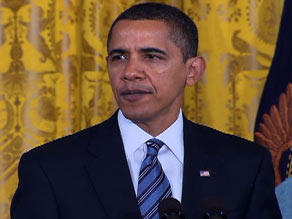
President Obama says AGI "finds itself in financial distress due to recklessness and greed."
 1 of 3

"This is a corporation that finds itself in financial distress due to recklessness and greed," Obama told politicians and reporters in the Roosevelt Room of the White House, where he and Treasury Secretary Tim Geithner were unveiling a package to aid the nation's small businesses.
The president expressed dismay and anger over the bonuses to executives at AIG, which has received $173 billion in U.S. government bailouts over the past six months.
"Under these circumstances, it's hard to understand how derivative traders at AIG warranted any bonuses, much less $165 million in extra pay. I mean, how do they justify this outrage to the taxpayers who are keeping the company afloat?"
...
But he said the impropriety of the bonuses goes beyond economics. "It's about our fundamental values," he said.
------------------------------
Update 3-18 (Liddy finally tells us)
I heard this bit on NPR this evening:
Liddy: "The people who were primarily responsible for Credit Default Swaps (CDS) that brought us to our knees -- they're gone. The people who were responsible for regulatory capital trades that have some exposure -- they're gone. But the people who still operate a $1.6 trillion trading book of business -- we aren't loosing the kind of dollars on that that we've lost on Credit Default Swaps. They are still there, and they're the ones that are winding that book of business down." [They got the retention bonuses?] Yes, they did."
Barney Frank: "So you're telling me the only bonuses that were paid recently are the retention bonuses?"
Liddy: "Yes."
Frank: "There were no other bonuses paid?"
Liddy: "Not at AIG FP. No, I don't think so."
So....we are left to wonder why this wasn't pointed out 2 days earlier. Did Liddy simply not understand the significance of this? I think he did not actually.
Even now, this new revelation that these bonuses were not for the CDS traders that most destroyed AIG isn't making the splash it should. This is because in the bigger picture, regardless that these bonuses aren't being paid to many of the worst offenders of the AIG of 2008 (or 2006, etc.), people still are aghast that there are such large bonuses at AIG, of any kind, to anyone.
The picture is still that just moderately clever folks doing trading and "winding down trades" are supposed to be worth millions, while a teacher or a plumber earns under $100,000 or under $50,000. This is justified on the basis that these traders are needed to prevent counterparties from taking advantage of taxpayer-owned AIG now.
And this is the essence of the larger problem. That trading (gambling) caused the problem, and now we are paying other traders to help mitigate it, and paying them millions.
That traders are worth millions each year, but scientists, teachers, engineers -- people who actually produce real gains for society -- are not.
March 11, 2009
Add Some Nuance to Bank Restructuring (Updated)
(Update: further refinement of bond haircut, and notes on the subject from The Baseline Scenario and Naked Capitalism blogs)
We often hear options about "temporarily nationalizing" or restructuring banks which lay out a choice between protecting creditors of banks (those who have loaned banks significant sums of money, also called bondholders) or wiping them out. Similar language is about whether to guarantee all bank debt, or only certain kinds. While it's widely said that bank restructuring of a failed bank should leave stock shareholders with nothing (since the bank itself is worth nothing on net), it's sometimes said that we can't wipe out the bondholders since this kind of bank debt is so widely held as an investment by pension funds and many other institutions.
Also, bank investors (creditors, bondholders) need some sense of what the rules are for the future, in order to have confidence enough to lend money to banks.
But just as in much of life, it isn't necessary to choose between 0% and 100% here.
One intermediate form of bondholder protection is to convert the bondholders of failed banks into shareholders in a taxpayer-restructured bank. But, this can reduce the upside for taxpayers, who sometimes will have put in far more money than the bondholders, unless the taxpayers get the great majority of the stock and bondholders relatively little. Even if such a scheme is followed, there remains the critical question of just exactly what percentage of the new stock the bondholders will get. Should they get exactly a proportion of the new stock that their original capital would represent as a percentage of the total money bondholders and taxpayers together put into the banks?
I have one little proposal. When bondholders of banks are given a return of their money, let the bondholders take a "haircut" (partial loss) exactly equal to a fixed multiple of the interest rate they would have gained if the bank hadn't failed.
In other words, if a bank bond has an interest rate of 6% and the multiple for bond haircuts in bank failures is set to 1.5, then when such a bank fails the bondholder takes a haircut of 9% (1.5 * 6%), receiving the remainder of his original capital (91% in our example just now) back during the federal restructuring of the bank.
In a case where debt is converted into new stock, the bondholder receives a share of stock in proportion to a reduced capital amount after a haircut and then in proportion within all capital sources for the bank, including taxpayer bailout money in all forms.
These two methods solve the problem of socializing too much of the losses onto taxpayers and the resulting reverse-robin hood effect of making bondholders perfectly whole at net middle-class taxpayer expense.
In the future, with the possibility of a real partial loss (yet also a limited, predefined risk), bank creditors/investors (bond buyers) would examine banks more carefully, and banks themselves in turn would be managed more prudently in order to attract capital.
Baseline Scenario points out declining confidence in bank bonds, and points out how the bond market is estimating the future of such banks. James Kwak also notes the Fed might try buying such bonds to increase confidence. This all begs the question of whether propping up such banks is a tenable solution. For another view on this see Edward Harrison's guest post on Naked Capitalism, in which he says we need to guarantee bondholders be made whole. But the need is to remove uncertainty, and this can be done by creating a defined haircut that is predictable and known, as I have suggested above.
We often hear options about "temporarily nationalizing" or restructuring banks which lay out a choice between protecting creditors of banks (those who have loaned banks significant sums of money, also called bondholders) or wiping them out. Similar language is about whether to guarantee all bank debt, or only certain kinds. While it's widely said that bank restructuring of a failed bank should leave stock shareholders with nothing (since the bank itself is worth nothing on net), it's sometimes said that we can't wipe out the bondholders since this kind of bank debt is so widely held as an investment by pension funds and many other institutions.
Also, bank investors (creditors, bondholders) need some sense of what the rules are for the future, in order to have confidence enough to lend money to banks.
But just as in much of life, it isn't necessary to choose between 0% and 100% here.
One intermediate form of bondholder protection is to convert the bondholders of failed banks into shareholders in a taxpayer-restructured bank. But, this can reduce the upside for taxpayers, who sometimes will have put in far more money than the bondholders, unless the taxpayers get the great majority of the stock and bondholders relatively little. Even if such a scheme is followed, there remains the critical question of just exactly what percentage of the new stock the bondholders will get. Should they get exactly a proportion of the new stock that their original capital would represent as a percentage of the total money bondholders and taxpayers together put into the banks?
I have one little proposal. When bondholders of banks are given a return of their money, let the bondholders take a "haircut" (partial loss) exactly equal to a fixed multiple of the interest rate they would have gained if the bank hadn't failed.
In other words, if a bank bond has an interest rate of 6% and the multiple for bond haircuts in bank failures is set to 1.5, then when such a bank fails the bondholder takes a haircut of 9% (1.5 * 6%), receiving the remainder of his original capital (91% in our example just now) back during the federal restructuring of the bank.
In a case where debt is converted into new stock, the bondholder receives a share of stock in proportion to a reduced capital amount after a haircut and then in proportion within all capital sources for the bank, including taxpayer bailout money in all forms.
These two methods solve the problem of socializing too much of the losses onto taxpayers and the resulting reverse-robin hood effect of making bondholders perfectly whole at net middle-class taxpayer expense.
In the future, with the possibility of a real partial loss (yet also a limited, predefined risk), bank creditors/investors (bond buyers) would examine banks more carefully, and banks themselves in turn would be managed more prudently in order to attract capital.
Baseline Scenario points out declining confidence in bank bonds, and points out how the bond market is estimating the future of such banks. James Kwak also notes the Fed might try buying such bonds to increase confidence. This all begs the question of whether propping up such banks is a tenable solution. For another view on this see Edward Harrison's guest post on Naked Capitalism, in which he says we need to guarantee bondholders be made whole. But the need is to remove uncertainty, and this can be done by creating a defined haircut that is predictable and known, as I have suggested above.
Geithner Mentions "Unsustainable" Debt vs Income
We've learned to expect Tim Geithner to be precise and careful to only say what a Secretary of the Treasury should say. We expect to hear him making confidence- enhancing comments and laying out plans in a way that aims to bring more people on board with the administration.
But it's hopeful, and I think genuinely confidence-enhancing, when a Secretary of the Treasury clearly states how things truly are.
We need to have a clear picture of the real situation, in order to be able to do something effective about it.
So I'm encouraged to hear this 33 minutes into Geithner's interview on Charlie Rose:
!
This is the basic reality we are dealing with.
All the other descriptions of our current situation that aren't centered on or in recognition of the fact of the credit bubble are either erroneous or beside the point. Even talking about wages is incomplete without an inclusion of the debt picture. Economics is not the entire picture of our lives, but so far as the economic and personal budget side of our lives goes, this is the most crucial fact.
I am reassured about Geithner's understanding of the situation -- that he can recognize and clearly state this central fact of unsustainable debt levels. Yes, we still have to wait to see just how willing the Fed and Treasury and Administration are to deal effectively with zombie banks, but at least there is no delusion about the real situation on the part of the Secretary of the Treasury. Since Geithner clearly understands the full picture (regardless of how he may estimate or misestimate the complexities of receivership), we can reasonably hope he'll correct mistakes and modify plans more quickly than without such an understanding.
Because the currently described plan has some flexibility -- for instance in just how much common stock taxpayers may end up holding in some banks in time -- we can plausibly imagine that the outcome would have some fairness for taxpayers in getting equity in banks (the potential for upside in return for their money). Until I see that we refuse to take a majority stake in Citigroup (for instance when certain guarantees cost us more as time passes), I am not going to presume that we won't "temporarily nationalize" (restructure, etc).
So we still have a possibility that Geithner's plan, or ongoing adjustments, could be a flexible and effective way of dealing with the banks that is good enough, within the context that there is no cheap or easy way out of this mess.
But it's hopeful, and I think genuinely confidence-enhancing, when a Secretary of the Treasury clearly states how things truly are.
We need to have a clear picture of the real situation, in order to be able to do something effective about it.
So I'm encouraged to hear this 33 minutes into Geithner's interview on Charlie Rose:
Geithner: "...if you look at the amount the American people were borrowing, relative to income, you just had a huge, unsustainable rise in the basic debt obligations of the American people.....
"You know, uh, people borrowed and spent beyond their means..."
!
This is the basic reality we are dealing with.
All the other descriptions of our current situation that aren't centered on or in recognition of the fact of the credit bubble are either erroneous or beside the point. Even talking about wages is incomplete without an inclusion of the debt picture. Economics is not the entire picture of our lives, but so far as the economic and personal budget side of our lives goes, this is the most crucial fact.
I am reassured about Geithner's understanding of the situation -- that he can recognize and clearly state this central fact of unsustainable debt levels. Yes, we still have to wait to see just how willing the Fed and Treasury and Administration are to deal effectively with zombie banks, but at least there is no delusion about the real situation on the part of the Secretary of the Treasury. Since Geithner clearly understands the full picture (regardless of how he may estimate or misestimate the complexities of receivership), we can reasonably hope he'll correct mistakes and modify plans more quickly than without such an understanding.
Because the currently described plan has some flexibility -- for instance in just how much common stock taxpayers may end up holding in some banks in time -- we can plausibly imagine that the outcome would have some fairness for taxpayers in getting equity in banks (the potential for upside in return for their money). Until I see that we refuse to take a majority stake in Citigroup (for instance when certain guarantees cost us more as time passes), I am not going to presume that we won't "temporarily nationalize" (restructure, etc).
So we still have a possibility that Geithner's plan, or ongoing adjustments, could be a flexible and effective way of dealing with the banks that is good enough, within the context that there is no cheap or easy way out of this mess.
March 4, 2009
Bad Ideas Commonly Believed to be Facts are Preventing Real Solutions
Reality is, by nature, more complex than any human understanding can be. Thus judgements in which we can have real confidence are limited to prescribed situations within systems of rules or simplifying constraints we have imposed. For instance, we can say 5 + 6 = 11 with real confidence, or that experience has shown repeatedly that a household paying more than about 1/3 of income on housing often experiences financial stress or unsustainable finances.
When we try to judge actions in a more complex system such as an entire economy -- for instance whether letting Lehman fail worsened the economic situation months later compared to what we think would have happened if Lehman had been in part bailed out and handled like Bear Stearns -- we are forced to gauge or ignore large numbers of variables, some of which we cannot find in limited time, and then choose what complexities to simplify and what guesses to make.
When our financial system sank into crisis more deeply after Lehman failed, some plausible simplifications suggested that the failure of Lehman must have worsened the crisis.
After all, when a dramatic event immediately proceeds a great change, its reasonable (and common) to imagine the event caused or influenced the change.
We often hear in the news that a wilderness fire was caused by a careless campfire or cigarette. We sometimes hear that these caused fires even in wilderness areas dry from years of drought.
We ignore the fact that a soaking rain a day or two earlier would have caused that same bit of flame to lead to nothing much at all.
Even a lightning strike is sometimes said to have caused a fire, like an unlucky accident.
It's as if we want to believe that fire itself is unnatural and out of place in nature.
A more sophisticated and realistic view, though, developed with the wisdom of time and experience, is to understand that wildfires arise naturally in response to cycles of rain and drought -- that fire is inevitable, sooner or later.
Occasionally, instead of blaming an individual or a lightning bolt, we rise to the more meaningful assessment that drought itself is a cause of a major wilderness fire, and sometimes even can admit the growth of underbrush due to past firefighting is a cause. We can then -- once we have this increased honesty and clear vision -- take valuable actions made possible through our better understanding.
We plan for fires once we achieve this higher level of clarity and knowledge. We can begin to have controlled fires in response to lingering dry conditions, in order to preempt the inevitable in a way that saves the property and homes we have in the area.
Just thinking more clearly changes the situation and allows us to do what later we see as simply the obvious.
There is a prejudice in favor of old ideas, no matter how poor and erroneous they are.
But honesty and clarity and bringing in more knowledge usually pay off. They improve the bottom line and the public outcome.
---------
So, which factor intensified this financial and economic crisis -- letting Lehman fail...or continuing fallout of the unsustainable levels of debt and leverage and from stratospheric house prices leading to foreclosures?
In other words, if we had bailed out Lehman or sold it off as we did with Bear Stearns, would that have prevented any worsening of the financial "crisis" months later, as more and more mortgages went sour and revenue streams from mortgage-backed securities and their derivatives disappeared and foreclosures spiraled ever higher?
In other words, if we stopped one careless camper from starting a big fire....would that have guaranteed there would be no fire later?
If your common sense says no, I think you are on the right track.
Stopping one careless campfire in a dry woods does not prevent lightning from striking a month or two or three later.
Applying a similar sophistication of including more information in our estimations of complex situations helps to reveal several false or simplistic beliefs that are commonplace today.
I'd like to list a few of the oversimplifications that are obstructing our body politic from finding the best solutions to our economic predicament. We need to think more clearly in order to prevent another Great Depression.
So, here they are, in no particular order -- the worst popular beliefs of the day:
-------------------------------------------
1. Letting Lehman fail worsened the financial and economic situation.
The financial and economic situation has progressively worsened because millions of homeowners can not afford to make the payments on their over-priced houses after the end of re-financing or equity withdrawal based on increasing prices, and are progressively, in an increasing accumulation of numbers, unable to pay. Lehman was only one of many inevitable results. ("If Lehman had been saved, at you and your children's expense, instead of at the expense of various investors, that would not have saved Washington Mutual (as an independent bank), IndyMac, Wachovia, Merrill Lynch, etc." -- more here)
What finally slowed the resulting inevitable financial crisis was only the massive blanket guarantees and money finally thrown by the Fed and Treasury into the banks. In effect, we have sprayed fire-slowing water across much of the entire dry financial wilderness in our area now. But there is a problem with the strategy -- significant stretches of forest are just temporarily dampened tinderboxes of essentially dry wood. We don't have the ability to truly make a heavy rain across the entire huge wilderness areas of dry forest. We need some controlled burns (aka some restructuring of some major banks and more widespread relief of impossible mortgage payments via foreclosure or write downs).
2. Foreclosures hurt everyone by driving down home prices in their neighborhoods.
Foreclosures are only making the inevitable more obvious.
House prices cannot be sustained at huge premiums above local rents and local incomes, because creative financing will eventually come to an end.
House prices inevitably will continue to come down after a housing speculation fever is gone, until they settle back to to their more normal price levels vs incomes and rents, which for the US will be similar to prices of circa 2000 or 2001 in many areas (based on Case-Shiller national prices), no matter what we do.
House prices will decline back to normal no matter what we do.
3. Increasing taxes on the richest Americans will hurt economic growth.
American economic history contradicts this idea several times, making it appear random. Once tax rates on the highest incomes come down below about 1/2 (50%), further reductions don't always correlate with better economic outcomes.
Be honest: if you were earning $300,000 or $500,000 a year, would you really work less because your marginal tax rate was 40% instead of 35%? The idea the 2011 rise in marginal rates will hurt the economy contradicts common sense as well as the actual history of economic growth in the U.S. Reducing taxes on the highest earners mattered when confiscatory rates well over 50% came down significantly. In contrast, Bush's 2003 tax cuts to lower top income tax rates from about 40% down to 35% and cut investment capital gains taxes even for the wealthiest can even be claimed to have backfired, correlating with less job and wage growth vs other periods which had higher tax rates. I think the most accurate conclusion is simply that once the top income tax rates are under 50% and top capital gains taxes under 30%, it does not matter much what they are, one way or the other, expect in terms of the benefits of balancing the federal budget and allowing the good forms of public investment to be funded.
4. Federal spending/investment is mostly wasteful and private investment is always better.
Some forms of public investment (federal spending) -- such as education, school lunch programs, and aid to families with children -- have huge payoffs, making us all wealthier in terms of future economic growth. It's common sense that spending a modest bit of the national wealth improving education and nutrition of our young will result in more productive capacity vs a situation where a large fraction of our population is handicapped for the long run by malnourishment and under-education. To consider interesting questions like public investment "crowding out" private investment see this.
-------------------------------------------
What we need in America is less "debate" between simplistic extremes, and instead a more intelligent process of bringing in more information to refine our popular ideas.
Less conflict, and more refinement.
Cooperative refinement of ideas will win out over loud argument any day and any year and in any era.
When we try to judge actions in a more complex system such as an entire economy -- for instance whether letting Lehman fail worsened the economic situation months later compared to what we think would have happened if Lehman had been in part bailed out and handled like Bear Stearns -- we are forced to gauge or ignore large numbers of variables, some of which we cannot find in limited time, and then choose what complexities to simplify and what guesses to make.
When our financial system sank into crisis more deeply after Lehman failed, some plausible simplifications suggested that the failure of Lehman must have worsened the crisis.
After all, when a dramatic event immediately proceeds a great change, its reasonable (and common) to imagine the event caused or influenced the change.
We often hear in the news that a wilderness fire was caused by a careless campfire or cigarette. We sometimes hear that these caused fires even in wilderness areas dry from years of drought.
We ignore the fact that a soaking rain a day or two earlier would have caused that same bit of flame to lead to nothing much at all.
Even a lightning strike is sometimes said to have caused a fire, like an unlucky accident.
It's as if we want to believe that fire itself is unnatural and out of place in nature.
A more sophisticated and realistic view, though, developed with the wisdom of time and experience, is to understand that wildfires arise naturally in response to cycles of rain and drought -- that fire is inevitable, sooner or later.
Occasionally, instead of blaming an individual or a lightning bolt, we rise to the more meaningful assessment that drought itself is a cause of a major wilderness fire, and sometimes even can admit the growth of underbrush due to past firefighting is a cause. We can then -- once we have this increased honesty and clear vision -- take valuable actions made possible through our better understanding.
We plan for fires once we achieve this higher level of clarity and knowledge. We can begin to have controlled fires in response to lingering dry conditions, in order to preempt the inevitable in a way that saves the property and homes we have in the area.
Just thinking more clearly changes the situation and allows us to do what later we see as simply the obvious.
There is a prejudice in favor of old ideas, no matter how poor and erroneous they are.
But honesty and clarity and bringing in more knowledge usually pay off. They improve the bottom line and the public outcome.
---------
So, which factor intensified this financial and economic crisis -- letting Lehman fail...or continuing fallout of the unsustainable levels of debt and leverage and from stratospheric house prices leading to foreclosures?
In other words, if we had bailed out Lehman or sold it off as we did with Bear Stearns, would that have prevented any worsening of the financial "crisis" months later, as more and more mortgages went sour and revenue streams from mortgage-backed securities and their derivatives disappeared and foreclosures spiraled ever higher?
In other words, if we stopped one careless camper from starting a big fire....would that have guaranteed there would be no fire later?
If your common sense says no, I think you are on the right track.
Stopping one careless campfire in a dry woods does not prevent lightning from striking a month or two or three later.
Applying a similar sophistication of including more information in our estimations of complex situations helps to reveal several false or simplistic beliefs that are commonplace today.
I'd like to list a few of the oversimplifications that are obstructing our body politic from finding the best solutions to our economic predicament. We need to think more clearly in order to prevent another Great Depression.
So, here they are, in no particular order -- the worst popular beliefs of the day:
-------------------------------------------
1. Letting Lehman fail worsened the financial and economic situation.
The financial and economic situation has progressively worsened because millions of homeowners can not afford to make the payments on their over-priced houses after the end of re-financing or equity withdrawal based on increasing prices, and are progressively, in an increasing accumulation of numbers, unable to pay. Lehman was only one of many inevitable results. ("If Lehman had been saved, at you and your children's expense, instead of at the expense of various investors, that would not have saved Washington Mutual (as an independent bank), IndyMac, Wachovia, Merrill Lynch, etc." -- more here)
What finally slowed the resulting inevitable financial crisis was only the massive blanket guarantees and money finally thrown by the Fed and Treasury into the banks. In effect, we have sprayed fire-slowing water across much of the entire dry financial wilderness in our area now. But there is a problem with the strategy -- significant stretches of forest are just temporarily dampened tinderboxes of essentially dry wood. We don't have the ability to truly make a heavy rain across the entire huge wilderness areas of dry forest. We need some controlled burns (aka some restructuring of some major banks and more widespread relief of impossible mortgage payments via foreclosure or write downs).
2. Foreclosures hurt everyone by driving down home prices in their neighborhoods.
Foreclosures are only making the inevitable more obvious.
House prices cannot be sustained at huge premiums above local rents and local incomes, because creative financing will eventually come to an end.
House prices inevitably will continue to come down after a housing speculation fever is gone, until they settle back to to their more normal price levels vs incomes and rents, which for the US will be similar to prices of circa 2000 or 2001 in many areas (based on Case-Shiller national prices), no matter what we do.
House prices will decline back to normal no matter what we do.
3. Increasing taxes on the richest Americans will hurt economic growth.
American economic history contradicts this idea several times, making it appear random. Once tax rates on the highest incomes come down below about 1/2 (50%), further reductions don't always correlate with better economic outcomes.
Be honest: if you were earning $300,000 or $500,000 a year, would you really work less because your marginal tax rate was 40% instead of 35%? The idea the 2011 rise in marginal rates will hurt the economy contradicts common sense as well as the actual history of economic growth in the U.S. Reducing taxes on the highest earners mattered when confiscatory rates well over 50% came down significantly. In contrast, Bush's 2003 tax cuts to lower top income tax rates from about 40% down to 35% and cut investment capital gains taxes even for the wealthiest can even be claimed to have backfired, correlating with less job and wage growth vs other periods which had higher tax rates. I think the most accurate conclusion is simply that once the top income tax rates are under 50% and top capital gains taxes under 30%, it does not matter much what they are, one way or the other, expect in terms of the benefits of balancing the federal budget and allowing the good forms of public investment to be funded.
4. Federal spending/investment is mostly wasteful and private investment is always better.
Some forms of public investment (federal spending) -- such as education, school lunch programs, and aid to families with children -- have huge payoffs, making us all wealthier in terms of future economic growth. It's common sense that spending a modest bit of the national wealth improving education and nutrition of our young will result in more productive capacity vs a situation where a large fraction of our population is handicapped for the long run by malnourishment and under-education. To consider interesting questions like public investment "crowding out" private investment see this.
-------------------------------------------
What we need in America is less "debate" between simplistic extremes, and instead a more intelligent process of bringing in more information to refine our popular ideas.
Less conflict, and more refinement.
Cooperative refinement of ideas will win out over loud argument any day and any year and in any era.
Subscribe to:
Posts (Atom)

 Posts
Posts

